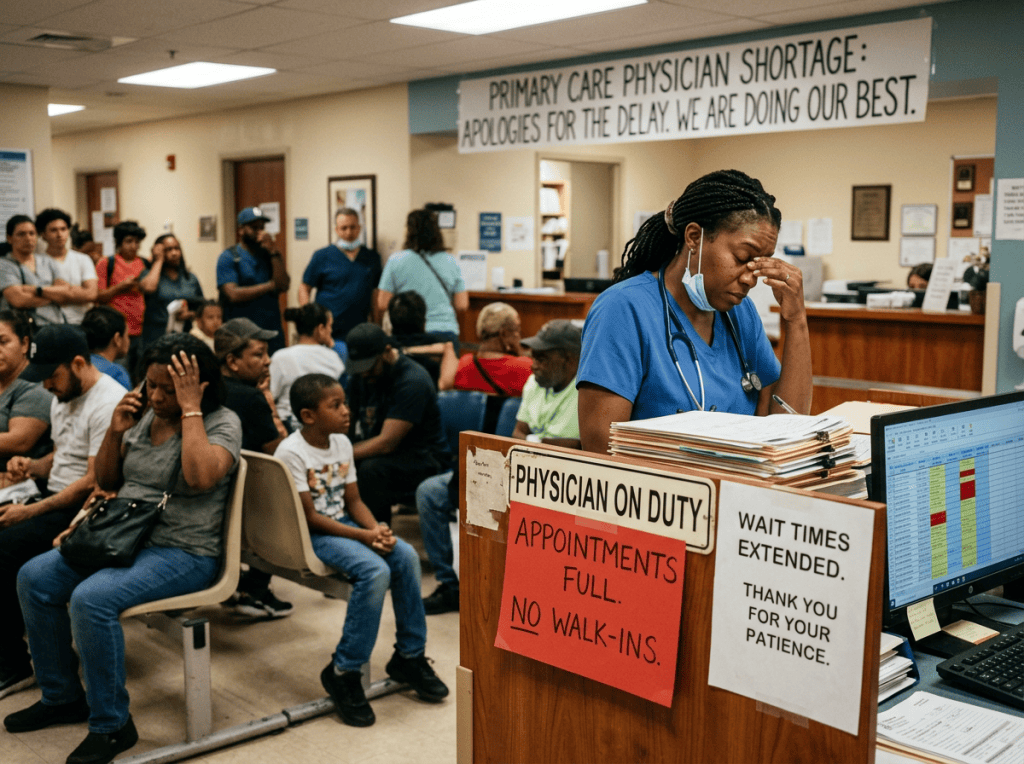
When people talk about a doctor shortage, I always thought it just meant we needed more doctors in general. But I started wondering if some types of doctors are harder to find than others. It turns out there are some pretty big differences.
HRSA, which studies the healthcare workforce in the U.S., projects that by 2038 there will be shortages in 30 out of the 35 physician specialties it looked at. Overall, HRSA projects the country will be short about 141,000 full-time doctors.
| Specialty | Projected supply compared with need | Approx. shortage |
|---|---|---|
| Vascular Surgery | 66% | 34% |
| Ophthalmology | 72% | 28% |
| Thoracic Surgery | 73% | 27% |
| Plastic Surgery | 74% | 26% |
| Family Medicine | 76% | 24% |
| Hospital Medicine | 78% | 22% |
| Allergy & Immunology | 83% | 17% |
| Anesthesiology | 83% | 17% |
| General Internal Medicine | 83% | 17% |
| Geriatrics* | 84% | 16% |
What surprised me most was seeing family medicine so high on the list. I probably would have guessed that a really specialized type of surgeon would be harder to find, but I wouldn’t have expected the doctors people see for everyday healthcare to have one of the larger projected shortages.
It also made me realize that having enough doctors isn’t just about how many doctors we have. It’s also about having enough of the right kinds of doctors in the places where people need them.
Source: HRSA report

