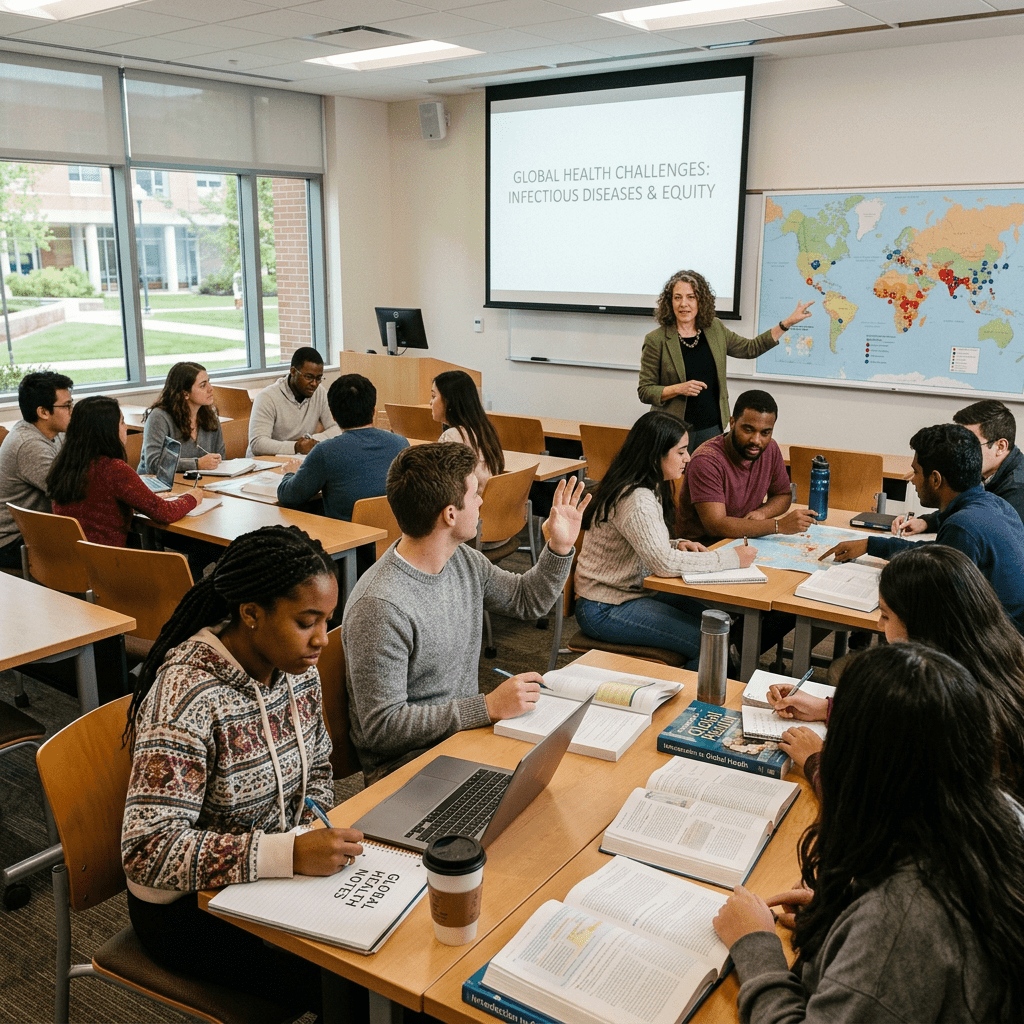
Global health is one of the most fascinating fields of study because it challenges us to look beyond hospitals and doctors’ offices and ask a deeper question: Why do some people become sick in the first place? While medicine often focuses on treating disease after it occurs, global health examines the broader factors that shape health outcomes, including access to clean water, nutrition, education, housing, economic opportunity, and healthcare services. As someone who is passionate about disease prevention and improving the lives of underserved populations, I am drawn to the idea that many of the world’s biggest health challenges can be fixed long before a patient ever enters a clinic. The courses I have outlined below show the interdisciplinary nature of global health, blending biology, epidemiology, public health, policy, economics, anthropology, and human rights. Together, these courses provide the knowledge and tools needed to understand not only how diseases affect communities, but also how sustainable, equitable solutions can improve health for populations around the world.
| Course Category | Course Title | Course Description |
|---|---|---|
| Foundational / Core | Introduction to Global Health | Surveys the major issues, actors, and frameworks in the field: the global burden of disease, health disparities between and within countries, and key organizations like the WHO and major NGOs. |
| Foundational / Core | Principles of Public Health | Covers the core functions of public health: prevention, health promotion, surveillance, and the difference between individual clinical care and population-level health. |
| Foundational / Core | Epidemiology | The study of how diseases spread and are distributed across populations. Teaches study design, measures of risk, and how to interpret outbreaks and health data. |
| Foundational / Core | Biostatistics | Statistical methods applied to health data: probability, sampling, hypothesis testing, and how to read and critique quantitative health research. |
| Foundational / Core | Human Biology / Health & Disease | Foundational biology of the human body and the mechanisms of common diseases, giving the biological grounding for later coursework. |
| Social & Structural | Social Determinants of Health | Examines how income, education, housing, race, gender, and environment shape health outcomes, often more than medical care itself. |
| Social & Structural | Medical Anthropology | Looks at how culture shapes beliefs about illness, healing, and the body, and why interventions succeed or fail in different communities. |
| Social & Structural | Global Health Policy & Health Systems | How health systems are organized, financed, and governed across different countries, and how policy decisions are made. |
| Social & Structural | Health Economics | Applies economic thinking to health: cost-effectiveness of interventions, financing, insurance, and resource allocation in low-resource settings. |
| Social & Structural | Global Health Ethics | Wrestles with moral questions in research and practice, such as equity, consent, and the responsibilities of wealthy nations and outside researchers. |
| Topical / Specialized | Infectious Diseases | Biology and control of communicable diseases like HIV/AIDS, tuberculosis, malaria, and emerging pandemics. |
| Topical / Specialized | Non-Communicable Diseases | The growing global burden of chronic conditions such as cardiovascular disease, diabetes, and cancer. |
| Topical / Specialized | Maternal & Child Health | Reproductive, maternal, newborn, and child health, including topics like family planning and child mortality. |
| Topical / Specialized | Environmental & Planetary Health | How water, sanitation, air quality, and climate change affect health worldwide. |
| Topical / Specialized | Nutrition in Global Health | Undernutrition, food insecurity, and the rising problem of obesity and diet-related disease. |
| Topical / Specialized | Global Mental Health | Mental health and substance use as a major and often neglected part of the global disease burden. |
| Topical / Specialized | Health & Human Rights | The intersection of health with human rights frameworks, including health in conflict and humanitarian settings. |
| Methods & Applied | Research Methods | Qualitative and quantitative approaches to designing and conducting health research ethically. |
| Methods & Applied | Program Planning, Monitoring & Evaluation | How to design a health intervention and measure whether it actually works. |
| Methods & Applied | Practicum / Field Experience | Supervised hands-on work, sometimes abroad, applying skills in a real organization or community. |
| Methods & Applied | Capstone / Senior Seminar | A culminating project that synthesizes coursework, often a research paper or applied project. |

