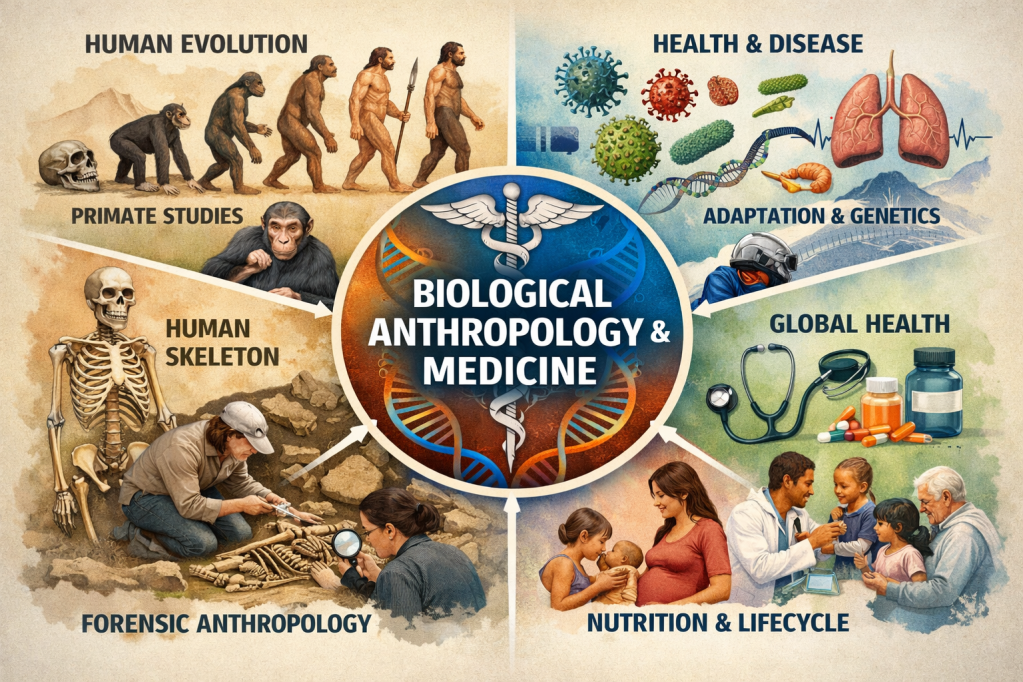
When most people think about medicine, they picture doctors, hospitals, and treatments. But medicine is also about understanding people, and that is where biological anthropology comes in. Biological anthropology looks at humans as living organisms. It studies how our bodies developed, how we adapt to different environments, and why certain populations experience different health outcomes. When you connect that with medicine, you start to see health in a much bigger way.
One of the biggest ideas in biological anthropology is that humans are shaped by both biology and environment. For example, people who live at high altitudes develop larger lungs because their bodies adapt to lower oxygen levels. That same idea can help doctors understand why some treatments work differently depending on where someone grew up or what conditions they live in. It shows that health is what is happening inside the body and also about the world around it.
Another important connection is how diseases spread and develop. Biological anthropologists study things like ancient skeletons, genetics, and population movements to understand how illnesses have changed over time. This helps explain why some communities are more vulnerable to certain diseases. Medicine uses this information to create better prevention strategies and treatments. It is like looking at the past to help solve problems in the present.
Biological anthropology also helps us understand health inequalities. Not everyone has the same access to food, clean water, or healthcare. Over time, these differences can affect growth, development, and even how the body responds to illness. When doctors and public health workers understand these patterns, they can design solutions that actually fit the needs of different communities instead of assuming everyone is the same.
What I find most interesting is how both fields remind us that humans are complex creatures. You cannot fully understand health by only looking at biology, and you cannot fully understand people by only looking at culture. Biological anthropology and medicine work best when they overlap. Together, they help explain not just how the body works, but why health problems happen in the first place.
Writing about this makes me want to learn more about how science and culture connect. It also makes me wonder what other fields might help us understand health in new ways.
 Health Before Healthcare
Leave a comment